DIY Rental Platform — Slice 5: Move-in Handover and AI-Assisted Condition Report
Slice 5 creates one immutable, party-authorized move-in condition report per tenancy: the landlord submits a structured baseline, the tenant records disputes and omissions, and the platform freezes both positions into canonical evidence and a deterministic PDF. AI may draft neutral photo descriptions only after uploader-specific consent, but the complete manual workflow ships first and remains fully functional without AI.
Summary
Slice 5 turns a landlord's move-in walkthrough and a tenant's review into one immutable evidence package without asking the platform to decide fault. The complete manual path ships first; optional AI only drafts neutral photo descriptions after the uploader consents and never controls report state.
- Depends on
2026-08-26-rental-platform-slice3-agreements-design.mdand2026-08-28-rental-platform-slice4-tenancy-payments-ai-design.md- Source brief
/Users/waynecheah/Downloads/DIY_Rental_Platform_Malaysia.md- Module
internal/modules/rental- Existing decisions
- ADR-0056, ADR-0059, ADR-0062
Outcome and scope
Success criteria
- At most one move-in Handover Report exists for a Tenancy.
- The landlord drafts areas, condition, inventory, keys/access devices, and initial meter readings.
- Creation and submission are allowed only from seven calendar days before through three calendar days after
starts_on, using Malaysia time. - The tenant gets exactly seven calendar days to review; neither party chooses the length.
- With the uploader's per-report consent and available Rental AI, each image may receive editable, unconfirmed area/item and neutral-condition suggestions.
- The tenant disputes entries, reports omissions, attaches optional evidence, and accepts the complete report once; there is no per-entry acceptance.
- The landlord may accept a correction or reply without rewriting the submitted baseline.
- Completion or deadline expiry finalizes the report. Silence is explicitly
no_tenant_response, never implicit acceptance. - Final structured evidence and its deterministic PDF cannot change after finalization.
- Media remains private and party-authorized; APIs disclose neither object keys nor public URLs.
Included evidence and surfaces
Structured baseline
landlord- Room/area condition
- Furnishings and appliances
- Keys, cards, remotes, access devices
- Initial electricity and water meter readings
Review evidence
both parties- Entry disputes and area omissions
- Alternating replies and either-party resolution
- Append-only comments and image evidence
- Explicit report-level tenant acceptance
Private media
JPEG/PNG- Immutable originals
- Display thumbnails
- Metadata-stripped AI derivatives
- Duplicate and low-resolution warnings
Party UI
SolidStartLandlord drafting and tenant review live beside the tenancy ledger and review queue in frontend/solidstart/apps/panel. No new app is created.
Non-goals
| Rejected capability | Why it stays out |
|---|---|
| Retrospective baseline or admin override | A late report would look authoritative without proving move-in condition. A missed window permanently means “move-in report not completed.” |
| Mandatory dispute resolution | An uncooperative party must not block finalization; the deadline freezes unresolved positions side by side. |
| AI adjudication | The model cannot accept, resolve, score damage, identify fault, estimate cost, classify wear, or recommend deposit action. |
| Video | It needs upload, transcoding, streaming, presentation, and AI pipelines. No media_kind or video enum is reserved; non-JPEG/PNG signatures are rejected. |
| Platform-admin evidence or per-report state | Case scope, purpose, access auditing, and retention are undesigned. Even status, dates, counts, and notification rows remain unavailable to staff. |
| Trusted capture time | EXIF/client timestamps are party-supplied evidence; authoritative server upload time is stored separately. |
Decisions and tradeoffs
Structured records first
Canonical structured snapshots are the evidence source of truth; PDF is a rendering.
Areas, entries, media, AI drafts, review threads, and future move-out comparison need addressable records. Baseline and final states are server-canonicalized and SHA-256 hashed.
Rejected: a PDF-first form whose annotations and model output become unstructured blobs.
One landlord baseline
The landlord submits one baseline; the tenant reviews that exact frozen state.
Item disputes, omitted-condition reports, and deadline outcomes protect the tenant without requiring a report-merging engine.
Rejected: two independent inspections that must be reconciled before either side understands the record.
Fixed seven-day review
review_due_on = max(starts_on, Malaysia submission date) + 7 calendar days.
The tenant bears the deadline's consequence, so the counterparty cannot shorten it. A platform constant protects the tenant across holidays and deletes an unused form knob, column, constraint, and bounds tests.
Rejected: landlord-selected 3–14 days and tenant-selected windows. If demand appears, only extension-only configurability should be considered.
Append-only review and one complete-report acceptance
Disputes, omissions, alternating replies, resolutions, and withdrawals append immutable events; the tenant accepts the full hash-bound state once.
Fifty to seventy individual entries make per-entry tapping busywork and weak evidence. One explicit acceptance of the exact review hash is clearer and stronger.
Rejected: mutable comments, per-entry acceptance, and synthetic acceptance after silence.
AI provenance without vendor details in evidence
Applying AI text permanently sets ai_assisted=true; provider/model/prompt/request/consent data remains internal.
The marker was visible when the party reviewed the text, so it belongs in snapshots and PDF. Vendor configuration does not describe the property and adds disclosure cost.
Area-name highlighting or prefilling alone does not set the marker. Editing applied AI text does not clear it.
Finalize before rendering
One database transaction stores the final structured snapshot/hash; PDF rendering is lazy and content-addressed.
Renderer or object-store failures cannot reopen evidence state or erase an acceptance.
Rejected: blocking legal state on synchronous PDF creation.
Lifecycle and invariants
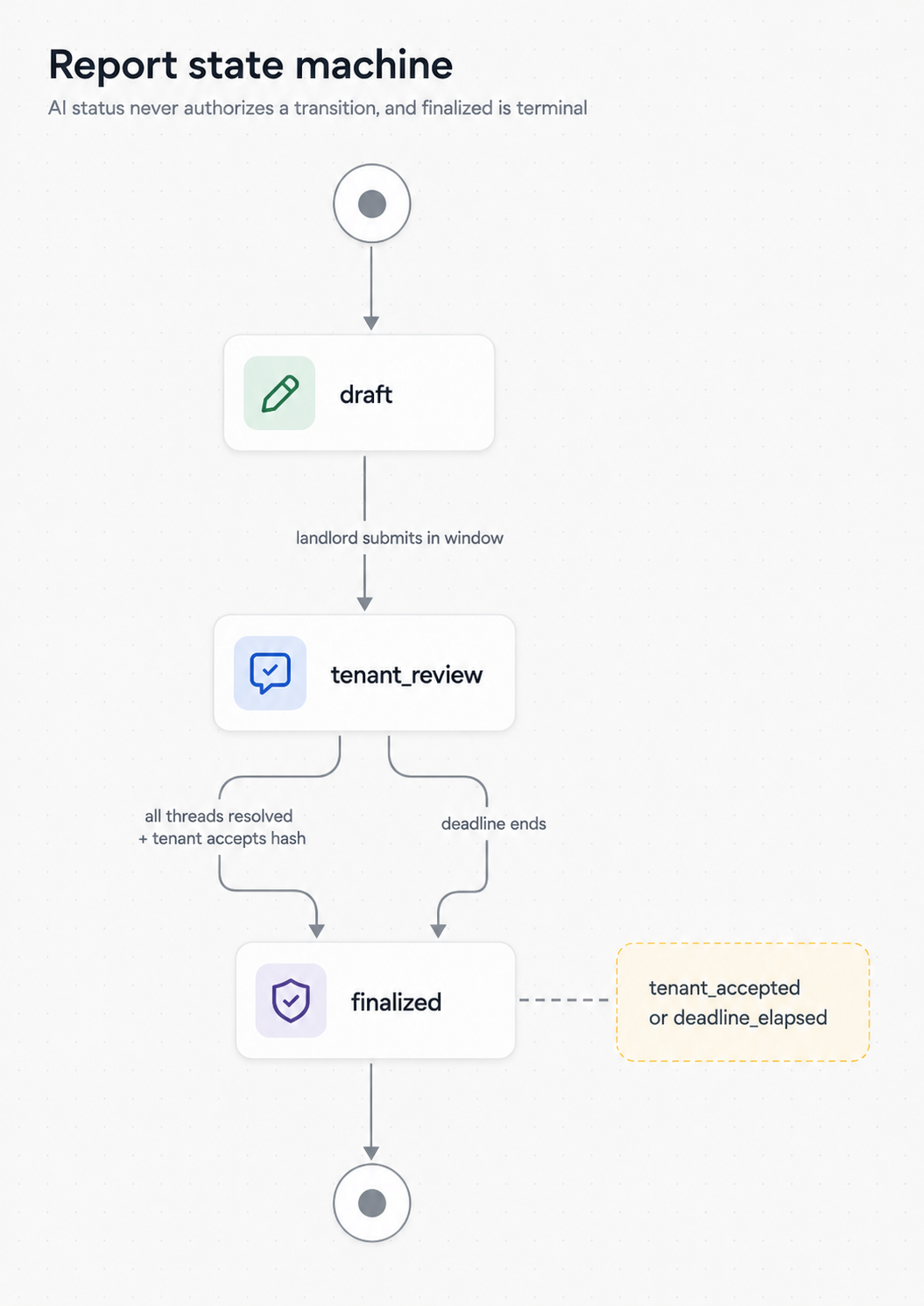
- Creation late boundary
- Allowed through
starts_on + 3inAsia/Kuala_Lumpur; later creation is refused so a user cannot start a permanently un-submittable draft. - Submission window
starts_on - 7throughstarts_on + 3calendar days, inclusive.- Review deadline
- Tenant may act through 23:59:59 Malaysia time on
review_due_on; the sweep finalizes only after the date ends. - Late agreement
- A tenancy established after its own window gets no report; the window is never re-anchored to establishment time.
- Only the tenancy landlord mutates the
draftbaseline. draft → tenant_reviewvalidates the window, entry requirements, ready evidence, and complete deterministic baseline snapshot in one transaction.- Areas, entries, and attached baseline media are immutable after submission.
- Responses append only during
tenant_review, through the end ofreview_due_on. - Early finalization requires every dispute and omission thread resolved plus one explicit tenant acceptance. It scans no per-entry review state.
- Deadline finalization preserves open disputes, labels undisputed entries
no_tenant_response, and creates no acceptance row. - The same undisputed entry is labelled
accepted_by_report_acceptanceafter explicit acceptance. - No transition leaves
finalized; AI has no transition authority.
Architecture and dependencies
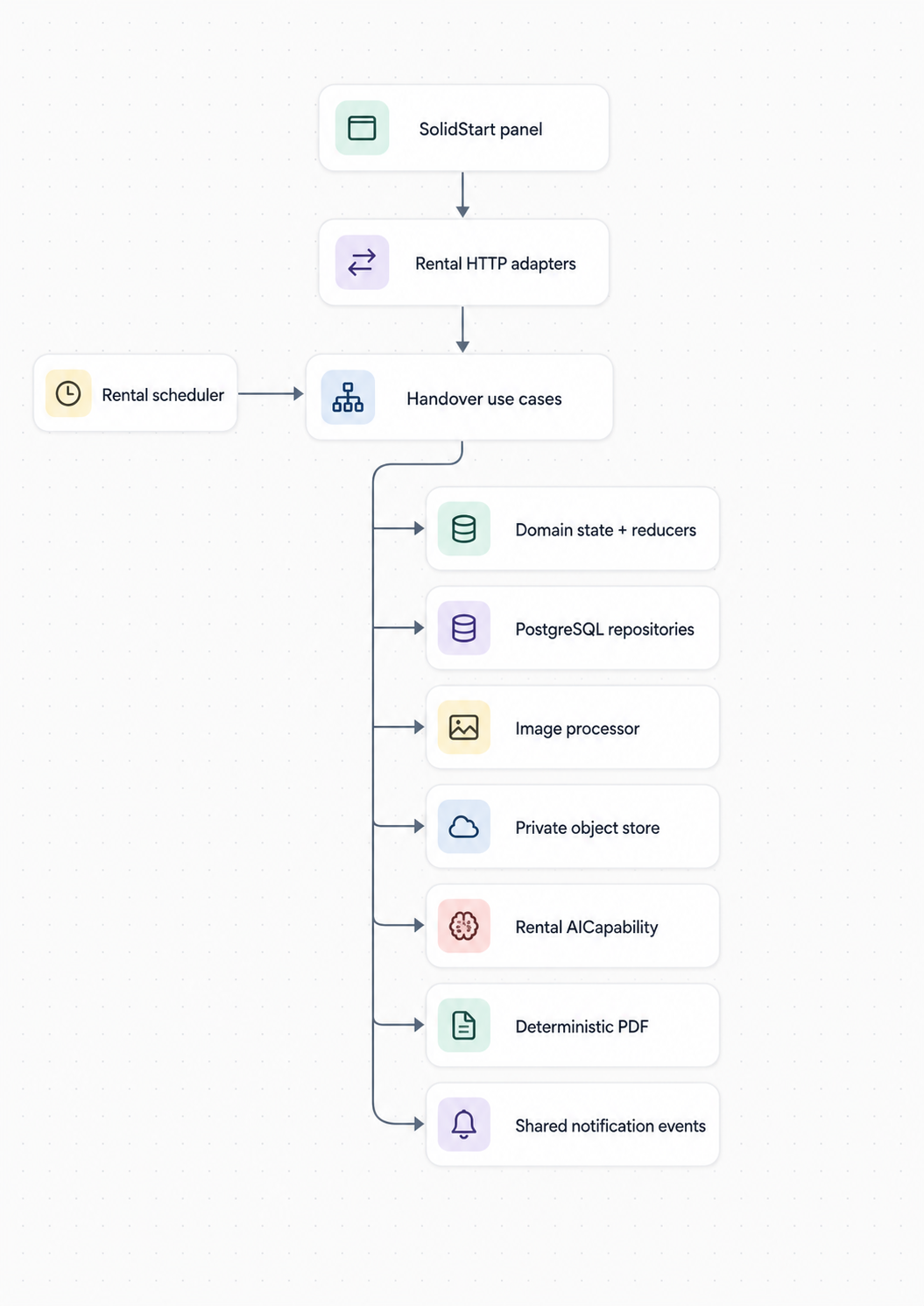
| Layer | Responsibility |
|---|---|
domain/entity/ | State machine, submission/review windows, entry validation, response reducer, finalization eligibility. |
application/port/ | Repositories, media store/processor, renderer, clock, narrow vision/prompt/gate ports. |
application/usecase/ | Create/edit, entries/media, submit, review events, accept/finalize, deadline sweep. |
adapter/inbound/http/ | Party-authorized report, media, response, acceptance, and document endpoints. |
adapter/outbound/persistence/postgresql/ | Repositories and transaction extensions. |
adapter/outbound/storage/ | Original, thumbnail, AI derivative, and final-document objects in the private bucket. |
adapter/outbound/image/ | Decode safety, orientation, resize, metadata stripping, thumbnail, resolution warning. |
adapter/outbound/pdf/ | Deterministic final-report rendering. |
Reused seams
- Rental's hexagonal layout and functional-option wiring.
- Private-bucket Go streaming already used for ownership/payment proofs.
- Slice 3 deterministic, content-addressed PDF pattern.
- Slice 4 product-scoped AI authorization, vision runner, prompt service, capability filtering, kill-switch, caps, access records, and usage records.
- Existing Rental scheduler pattern and Slice 4's shared notification claim/retry worker.
The application container supplies a present-or-absent AICapability. Tests replace AI, image processing, storage, rendering, mail, and clock through functional options. Report use cases know no provider names and import no external AI adapter.
Data model
All tables are Rental-owned and created through migrator_rental.go. Action times are TIMESTAMPTZ; user-facing lifecycle boundaries are Malaysian calendar DATE values.
Reports, areas, and entries
| Table | Columns and constraints | Semantics |
|---|---|---|
rental_handover_reports | id, tenancy_id, report_type, status, submitted_at, submitted_ip, submitted_user_agent, review_due_on, baseline_snapshot, baseline_sha256, final_snapshot, final_snapshot_sha256, finalization_reason, finalized_at, document_key, document_sha256, created_at, updated_at | report_type=move_in for Slice 5; unique (tenancy_id, report_type). Status: draft, tenant_review, finalized. Reason: tenant_accepted or deadline_elapsed. Snapshots are server-produced; keys and submission IP/user-agent are never serialized. |
rental_handover_areas | id, report_id, name, sort_order, created_at | Landlord-defined names, required and unique per report after trim/case-fold. Immutable after submission. Every area needs one ready baseline image. |
rental_handover_entries | id, report_id, area_id, entry_type, label, condition_note, quantity, meter_value, meter_unit, ai_assisted, sort_order, created_at | Immutable baseline records. Type-specific validation controls which quantity, condition, and meter fields are allowed. |
| Entry type | Required | Forbidden or extra rule |
|---|---|---|
condition | Label + condition note | No quantity or meter fields. |
inventory | Label + quantity + condition note | No meter fields. |
access_device | Label + quantity | Condition optional; no meter fields. |
meter_reading | Label + value + unit + directly attached ready image | No quantity. Value is non-negative NUMERIC(12,3); unit is kwh or m3. |
Media and AI tables
rental_handover_media — lifecycle, targets, and idempotency
id, report_id, area_id, entry_id, response_id, uploader_user_id, upload_request_id, status, original_key, thumbnail_key, ai_derivative_key, mime_type, byte_size, pixel_width, pixel_height, original_sha256, thumbnail_sha256, reported_captured_at, uploaded_at, attached_at, quality_warnings, created_at, updated_at
- No
media_kind: every row is an image. Status isuploading,ready, orfailed. - A ready attached row targets exactly one area, entry, or response. Staged rows may have no target during bulk upload.
- Only the uploader may attach staged media through
PATCH /handover-media/:id, to a same-report target while its workflow is editable. - Unattached staged uploads are omitted from snapshots and swept after 24 hours. Retry before cleanup resumes the lifecycle; after cleanup it returns 410 and requires a new upload.
(uploader_user_id, upload_request_id)is unique. Quality warnings contain deterministic codes, never AI prose.
rental_handover_ai_suggestions — immutable attempts
id, media_id, request_id, status, suggested_area, suggested_item, condition_note, provider, model, prompt_version, consent_version, consent_provider, consent_config_version, consented_at, processed_at, created_at
Status is succeeded, unavailable, failed, or invalid. request_id is unique and reused by the AI Access Event. Repeating the request returns the attempt; an explicit retry uses a new ID. Active means the latest success by processed_at, id. Consent columns are copied at call time so later withdrawal or re-consent cannot rewrite history.
rental_handover_ai_consents — one current authorization per uploader/report
id, report_id, user_id, disclosure_version, provider, config_version, consented_at, withdrawn_at, created_at, updated_at
Unique on (report_id, user_id). The row is updated in place; immutable provenance is copied to suggestion attempts. Each analyze call checks the media's uploader, active consent, provider, and config version. Withdrawal stops future calls without deleting history; re-consent clears withdrawn_at and updates the disclosure/config.
Review and acceptance tables
rental_handover_responses — append-only thread events
id, report_id, thread_id, target_entry_id, target_area_id, actor_user_id, actor_role, action, comment, ai_assisted, created_at
| Action | Who and effect |
|---|---|
dispute_entry | Tenant opens a thread against exactly one baseline entry. |
report_omission | Tenant opens a thread against exactly one baseline area; the system invents no entry. |
reply | Either party, required comment, optional ready media; never twice consecutively by the same actor. |
resolve | Only the party who did not speak last accepts the other side's current position. |
withdraw | Tenant retracts their own dispute or omission. |
Every row belongs to a thread. The application reduces current state before insert; no row is updated or deleted. Alternation preserves the tenant's right to answer a landlord rebuttal without turning the feature into unlimited chat: the seven-day deadline ends the exchange and per-party media budgets bound it.
rental_handover_acceptances — explicit tenant acceptance only
id, report_id, user_id, accepted_snapshot_sha256, accepted_at, ip_address, user_agent, created_at
Unique on report_id. The accept command echoes the rendered review_state_sha256; under the report lock the server recomputes it, refuses mismatch, and stores the identical hash. Baseline submission creates no acceptance. There is no party_role, no server-manufactured landlord acceptance, and audit IP/user-agent appears in no API, snapshot, or PDF.
Shared notification table
Slice 5 creates no notification table. It uses Slice 4's ADR-0062 table:
rental_notification_events(id, subject_type, subject_id, kind, recipient_user_id, status, attempt_count, next_attempt_at, last_error, provider_message_id, sent_at, created_at, updated_at)
The natural key is unique on (subject_type, subject_id, kind, recipient_user_id). Report-grain events use subject_type=handover_report; each response-grain event uses handover_response with the append-only response ID. Slice 5 does not write Slice 4's superseded status.
Canonical evidence
Canonicalization is server-owned, versioned with schema_version, and defined independently of Go map iteration, host timezone, storage keys, or database-driver numeric formatting.
- Report/tenancy identifiers, party display names, property display address, start date.
- Literal seven-day review rule.
- Sorted areas and entries, attached original SHA-256 values, uploader, authoritative upload times.
- Landlord submission time and every entry's
ai_assistedvalue.
- Every response in deterministic order, including
ai_assistedand media hashes. - Landlord submission act and baseline hash.
- Tenant acceptance timestamp/hash if present.
- Reduced resolved, unresolved, and no-response outcomes plus finalization reason/time.
- Area and entry ordering
sort_order, then ID- Media ordering
- Authoritative upload time, then ID
- Response ordering
- Server timestamp, then ID
- Meter serialization
- Exactly three decimal places:
88.400, never88.4 - Other fixed rules
- JSON key order, timestamp format, and null handling
Party-authored labels, notes, comments, and replies are stored and rendered exactly as typed in UI, snapshots, PDF, and future comparisons. Only surrounding chrome is English; translating evidence would put words into a party's mouth.
AI boundary
Strict call contract
- Feature
rental:condition_photo_describe- Product and mode
rental, platform mode; no landlord or tenant BYOK- Locale
en-MY; English-only chrome, PDF labels, and model output- Input
- One consented metadata-stripped normalized derivative plus prompt; no object URL or user/NRIC/address/agreement/message data
- Governance
- Slice 4 vision-capability filter, global kill-switch, product caps, access event, usage record
{
  "suggested_area": "Kitchen",
  "suggested_item": "Lower cabinet door",
  "condition_note": "Visible horizontal scratch near the lower-left edge"
}
Every field is nullable, and null is the only uncertainty signal. The parser rejects prose, extra fields, overlong strings, and prohibited categories. An earlier unreadable_or_uncertain array was removed because it duplicated null, had no consumer, and invited editorialization.
Prohibited and permitted language
moneyRM, ringgit, cost, price, quote, estimate, currency-adjacent digitsrejectliabilityfault, blame, negligent, responsible, liable, caused byrejectdepositdeposit, deduct, forfeit, withholdrejectadjudicationwear and tear, normal wear, pre-existing, tenant caused, landlord causedrejectrepairneeds repair, must be replaced, should be fixedrejectseveritysevere, serious, major, minor, badly, slightreject
Multi-word items are phrase tests. Visible-defect nouns such as damaged, scratch, stain, crack, chip, dent, mould, missing, and discoloured are permitted: they describe visible condition; severity grading is the first step toward a verdict. Party-authored text is never filtered.
Graceful absence and human authority
If AI is absent, disabled, capped, timed out, or invalid, the stored media remains ready and the uploader types manually. The media API reports AI status separately; a provider failure never turns successful evidence storage into HTTP 5xx.
Media flow and budgets
Upload and processing
- Create or resume lifecycle
An authenticated party supplies an idempotency key inside an editable workflow. Repeating it returns the existing lifecycle.
- Preflight
Validate declared type and size; create
uploadingrow and private report/media key. - Store original
Stream immutable bytes to the private store.
- Decode safely
Verify actual JPEG/PNG signature and safe pixel dimensions; fix orientation; reject decompression hazards.
- Derive
Create thumbnail and bounded, reoriented, EXIF/location-free AI copy; compute original SHA-256 and low-resolution warning.
- Commit readiness
Write all derivatives before marking
ready. Failed rows stay out of snapshots and remain retryable/removable while editable.
| Format or condition | Outcome |
|---|---|
| JPEG or PNG within limits | Accepted after signature/decode checks. |
| HEIC | Specific 422 naming HEIC and asking the user to re-save as JPEG. Mobile Safari often converts, but not every share path does. |
| WebP | Rejected; Go's available decoder cannot encode it, creating unnecessary format asymmetry. |
| Video or renamed/invalid bytes | 422 before storage and before AI; no reserved schema path. |
| Duplicate bytes | Accepted as ready with a private warning; never deleted or treated as fraud. |
| Low resolution | Warning only; uploader decides whether to keep it. |
Separate party budgets
image bytesHard limit per JPEG/PNG before storage or AI5 MBbaseline/reportLandlord-owned total100baseline/targetLandlord-owned per area or entry10response/reportCounted separately for each party50response/threadCounted separately for each party10
A shared pool is rejected because a thorough landlord baseline could consume the tenant's ability to prove an omission, and one party could crowd out the other's thread reply. These are conservative sizing assumptions, not validated market facts. Drafting UI must show remaining baseline capacity before the walkthrough becomes impossible to repeat.
Optional analysis
- Verify uploader consent
Check active per-report consent for the media's uploader and the active provider/config version. Mismatch or withdrawal sends no image, records
unavailable, and prompts that uploader once. - Authorize governed feature
Load the prompt and authorize
rental:condition_photo_describeunder productrental. - Send minimal derivative
Pass only the metadata-stripped normalized bytes and prompt, with no object URL or unrelated tenancy data.
- Record attempt
Persist usage/error through the shared capability, parse strict nullable output, and copy consent provenance into the immutable suggestion row.
- Let the human author evidence
Show editable draft text. Area matching is client-side trim/case-fold highlighting or prefilling only; the server does no fuzzy model-driven assignment.
Party workflows
Landlord draft and submit
- Create idempotently
From the tenancy dashboard, require an existing Tenancy, the tenancy landlord, and Malaysian date no later than
starts_on + 3. - Build the draft
Suggested common areas are UI conveniences. The landlord adds, renames, reorders, or removes areas and records condition, inventory, access, and meter entries.
- Attach evidence
Upload images, optionally apply/edit AI labels and notes, and see missing fields, areas without images, meters without direct evidence, and remaining capacity.
- Submit atomically
Lock report/tenancy; validate party, status, window, entries, ready media, per-area images, and meter images; canonicalize and hash baseline; derive
review_due_on; store submit audit data; entertenant_review; enqueue tenant notification.
The submission transaction calls no AI, storage, image processor, mail transport, or PDF renderer.
Tenant review and thread exchange
- Review the exact baseline
The tenant sees the frozen snapshot and remaining time. Undisputed entries need no action.
- Open specific claims
Dispute any entry with required comment and optional evidence, or report an omitted condition against an area.
- Alternate positions
Either party replies with required text and optional ready evidence; the actor who spoke last cannot reply again.
- Resolve or withdraw
The other actor may resolve by accepting the current position; the tenant may withdraw their own dispute or omission. All prior events remain visible.
- Freeze disagreement if necessary
The deadline closes any still-open thread with both positions side by side. Nothing adjudicates it.
Early and deadline finalization
Tenant acceptance
- Precondition
- Every thread resolved
- Request
reviewed_snapshot_sha256- Reason
tenant_accepted
Under the report lock, recompute the review state. A stale hash returns 409 with current state; a match inserts the sole acceptance, stores final snapshot/hash, and enqueues both final notices.
Automatic deadline sweep
- Precondition
- Malaysia review date has ended
- Acceptance
- None created
- Reason
deadline_elapsed
The sweep reduces responses, preserves open disputes, derives no-response outcomes, and stores the same canonical final evidence shape.
Acceptance and the sweep lock the same report row. Whichever commits first finalizes; the loser receives 409 with the finalized representation.
Final document
First authorized download renders final_snapshot, pins creation date to finalized_at, and caches deterministic bytes under the content hash. It groups by area and prints baseline observations, thumbnails, dispute/omission evidence, alternating replies/resolutions, resolved/unresolved/no-response labels, meter values, access quantities, separately labelled submission and tenant-acceptance timestamps/hashes, and the non-adjudication statement.
Authorization, privacy, and retention
| Action | Authorized caller |
|---|---|
| Create/edit/submit baseline; baseline upload | Tenancy landlord, while draft and within applicable window. |
| View draft and media | Landlord only; tenant discovery is empty and every direct report/media/document route is 404. |
| View submitted report and attached media | Verified tenancy landlord or tenant. |
| Dispute entry/report omission | Tenancy tenant during review. |
| Upload thread evidence; reply/resolve | Either tenancy party when it is their turn on an open thread. |
| Accept complete report | Tenancy tenant when every thread is resolved. |
| Download final PDF/originals | Tenancy landlord or tenant. |
| Give/withdraw AI consent | Each party for their own uploads on that report. |
| Configure/inspect Rental AI usage | Existing platform-admin AI authority, without handover evidence or report state. |
Object keys and AI credentials never enter API responses or snapshots. The other tenancy party sees the ai_assisted marker, but provider/model/prompt/request/consent/raw-suggestion provenance remains internal. Original evidence may expose uploader-supplied metadata to the counterparty after explicit upload disclosure; only stripped derivatives leave the platform for AI.
Provisional retention position
- Malaysia PDPA 2010's Retention Principle argues against indefinite storage of home photos, IP addresses, and user agents.
- Limitation Act 1953 section 6 motivates six years for contract actions, but time runs from cause-of-action accrual, not automatically
ends_on. The chosen anchor is a product simplification because it is the date this module owns. - A later lifecycle design must revisit the anchor if deposit or other claims accrue later and implement legal/dispute holds.
- One party cannot unilaterally erase shared evidence while its purpose remains; proper request handling belongs to the deferred case-scoped capability.
HTTP contract
POST   /api/rental/tenancies/:id/handover-reports/move-in
GET    /api/rental/tenancies/:id/handover-reports
GET    /api/rental/handover-reports/:id

POST   /api/rental/handover-reports/:id/areas
PATCH  /api/rental/handover-areas/:id
DELETE /api/rental/handover-areas/:id

POST   /api/rental/handover-reports/:id/entries
PATCH  /api/rental/handover-entries/:id
DELETE /api/rental/handover-entries/:id

POST   /api/rental/handover-reports/:id/ai-consent
DELETE /api/rental/handover-reports/:id/ai-consent

POST   /api/rental/handover-reports/:id/media
PATCH  /api/rental/handover-media/:id
GET    /api/rental/handover-media/:id/content?variant=thumbnail|original
POST   /api/rental/handover-media/:id/analyze
DELETE /api/rental/handover-media/:id

POST   /api/rental/handover-reports/:id/submit
POST   /api/rental/handover-reports/:id/responses
POST   /api/rental/handover-reports/:id/accept
GET /api/rental/handover-reports/:id/document- No report PATCH
- After removing configurable review length, every report field is server-owned; route absence communicates that contract.
- Media content default
variant=thumbnail; omission must not stream up to 500 MB across 100 drafting tiles.- Forbidden variant
ai_derivativeis explicitly rejected; it is a provider-processing artifact, not evidence or a party rendering.- Variant privacy/cache
- Thumbnail and original share identical party authorization and
Cache-Control: private. Each validator matches returned bytes; never validate a thumbnail withoriginal_sha256. - Review-state echo
GET /handover-reports/:idreturns exactly thereview_state_sha256the client must echo on acceptance.- Discovery summary
id, status, review_due_on, finalized_at, finalization_reason; never entries, comments, or media.
Discovery is state-aware: a draft exists only for the landlord. From submission onward both parties discover and read the same frozen baseline. After the late boundary, an empty list becomes the permanent “move-in report not completed” state visible to either party.
PATCH /handover-media/:id accepts exactly one of area_id, entry_id, or response_id, from the uploader, within the same report and editable workflow. It patches no bytes, hashes, or warnings. Delete applies only to caller-uploaded staged or draft-baseline media. Responses are validated commands; no generic response PATCH/DELETE exists.
Notifications and errors
Durable notifications
| Kind | Recipient and trigger | Subject grain |
|---|---|---|
review_opened | Tenant after baseline submission | Handover report |
review_due_soon | Tenant two calendar days before due date if not finalized | Handover report |
thread_response | The party who did not act, after each reply or resolution | Append-only response |
report_finalized | Both parties after either path | Handover report |
Every kind is durable: each has a collision-free natural key and is harmful to lose. Slice 4's single worker claims, retries, and backs off the same row. Delivery failure never moves a deadline. Provider idempotency uses the event ID when available, but ambiguous network failures may still duplicate mail.
Error contract
| Situation | Behaviour |
|---|---|
| Duplicate create | Return existing report idempotently. |
| Missing Tenancy / wrong caller | 404 for missing tenancy; 403 for non-party. |
Create after starts_on + 3 | 409; no draft; permanent not-completed state. |
| Submit outside window | 409; draft remains editable but cannot become a baseline after the late edge. |
| Incomplete/invalid baseline | 422 with itemized missing area/image/entry/meter problems. |
| Baseline mutation after submission | 409. |
| Unsupported/renamed/oversize/unsafe media | 422 before AI; HEIC gets a specific re-save-as-JPEG message. |
| Object write failure | Media unavailable; report unchanged; retry/remove while editable. |
| AI absent, denied, capped, failed, or invalid | Media succeeds; AI status reports fallback; manual entry works. |
| No/mismatched/withdrawn uploader consent | No Gate/Runner/provider payload; immutable attempt is unavailable; prompt correct uploader once. |
| Cross-party consent attempt | Refused by (report_id, user_id) uploader check. |
| Any media budget + 1 | 422 before storage/AI naming the exhausted budget. |
| Tenant action outside review | 409. |
| Accept with open thread | 409 listing unresolved targets. |
| Missing/stale review hash | 422 if absent; 409 plus current representation if stale; write no acceptance. |
| Invalid thread action | 409 for missing/resolved thread, consecutive same-actor replies, or accepting one's own position. |
| Acceptance/sweep race | One row lock winner; loser receives finalized state/409. |
| Final snapshot failure | Stay in tenant_review; retry later. |
| PDF render/store failure | Remain finalized; download returns 502; later request regenerates. |
| Third-party report/media/document request | 403 without object metadata or bytes. |
Test strategy
State, windows, snapshots, and finalization
- All valid/invalid state transitions and no exit from finalized.
- Month/year boundaries, leap day, Malaysia conversion, both window edges, instants outside, creation on
+3, refusal on+4, and a tenancy established after its window with no draft row. - Fixed seven-day due date with no request override and literal rule in the snapshot.
- Baseline atomicity under injected snapshot-write failure and immutability on every baseline mutation endpoint.
- Semantic-equivalent insertion/map order, host timezone, JSON implementation, and numeric formatting converge on one SHA-256.
- No manufactured acceptance; only tenant accept writes the sole row. Audit IP/user-agent appears in no API, snapshot, or PDF.
- Early acceptance with zero or resolved disputes, refusal for open threads, stale/absent echo writes nothing, and stored/echoed/recomputed hashes match.
- Acceptance/sweep concurrency produces one final snapshot and finalization notification set.
- Outcome labels distinguish explicit acceptance from deadline no-response, with no synthetic deadline acceptance.
Entries, responses, and media
- All type-specific required/forbidden entry fields; area and meter image requirements.
- Meter unit outside
kwh/m3, negative values,NUMERIC(12,3)round-trip, and identical88.4/88.400hashes. - Reducer coverage for dispute, omission, alternating replies, either-party resolution, withdrawal, invalid repeats, own-position resolution, unresolved deadline, and absence of per-entry acceptance.
- Thumbnail default, original streaming, AI-derivative rejection, same authorization, no object keys, and per-representation validators.
- JPEG/PNG signatures, specific HEIC and WebP rejection, 5 MB edge, decoded-dimension safety, orientation, thumbnail/derivative creation, EXIF removal, and original hash.
- Every media budget at limit and limit+1 before storage/AI; one party's capacity never reduces the other's.
- Attachment requires exactly one same-report target and uploader; refuses zero/two targets, cross-report, non-uploader, or frozen workflow; patches no immutable fields.
AI, privacy, documents, and notifications
- No consent means no Gate/Runner; provider request contains only derivative and prompt, not identity/address/agreement/messages.
ai_assistedsets only on applied evidence text, survives subsequent edits, ignores area-name convenience, appears in snapshots/hashes/PDF, and never leaks vendor or raw-suggestion details.- Consent covers one uploader's report images, never crosses parties; provider/config change blocks; withdrawal preserves history; re-consent updates same row; copied provenance never changes.
- Parser covers nullable success, prose, extra fields, length, every prohibited category and multi-word phrase, while visible-defect nouns including
damagedpass and party text is never filtered. - Human-authority golden test proves AI cannot mutate baseline, respond, resolve, accept, or finalize; complete upload-to-final path passes with AI absent/failing.
- Draft visibility gives tenant empty discovery and 404 direct routes until submission.
- Privacy golden test covers every platform role against media, party text, snapshots, document, report metadata, counts, and notification rows.
- PDF determinism across host timezones and concurrent first downloads.
- Notification natural-key uniqueness, retry through shared worker, unchanged deadlines, and distinct opposite-party events for multiple replies.
Delivery plan
Complete manual handover
Steps 1–9 ship draft → submit → review → finalize → deterministic PDF with no AI tables, endpoints, calls, or true ai_assisted values.
Release 5b · Optional AI assistant
Step 10 adds consent, governed analysis, parser/provenance, and opt-in UI only after 5a passes end to end. Provider readiness cannot block 5a.
- Prerequisites
Land Slices 3/4: Tenancy and product-scoped vision.
- Domain + draft
Entities, migrations, rules, repositories, APIs.
- Private media
Decode safety, derivatives, limits; real-device iOS Safari test.
- Landlord UI
Drafting and baseline validation in panel.
- Submit
Atomic snapshot/hash, audit metadata, tenant notice.
- Review
Append-only reducer, omissions, alternating replies, tenant UI.
- Finalize
Acceptance, deadline sweep, final snapshot/UI.
- Document
Lazy deterministic PDF and concurrency tests.
- AI
Prompt/parser/provenance and opt-in assistant UI.
Release acceptance
| Release | Must prove |
|---|---|
| 5a | Landlord drafts/submits stable baseline in-window; tenant notification/review/disputes/omissions/evidence work; alternating replies and either-party resolution enforce turn rules; hash-bound early and no-response deadline finalization both work; snapshots and deterministic PDF are produced; notifications are durable/retryable; non-party access fails; no AI implementation exists. |
| 5b | Each uploader consents once per report and re-consents only after config/provider change or withdrawal; analysis checks the media uploader; all prohibited categories reject safely; only applied text is marked; no vendor/provenance leak reaches evidence; every 5a criterion still passes when AI is disabled, capped, or failing. |
Risks and open questions
| Risk | Mitigation or accepted consequence |
|---|---|
| AI sounds like a damage verdict | Strict nullable schema, neutral prompt/copy, six prohibited categories with tests, user confirmation, and no model transition authority. |
| New AI locale silently bypasses English guards | English-only en-MY; reviewed language-specific denylist/tests must land before any locale enablement. |
| Landlord omits or later changes an issue | Tenant area-level omission with evidence; baseline hash and immutability after submission. |
| Tenant silent or parties disagree | Deadline records explicit no-response or freezes both positions; never implies acceptance and never blocks indefinitely. |
| Late report appears credible | Hard creation/submission window, no re-anchoring, no backdating/admin override. |
| Metadata reaches AI or counterparty | AI gets EXIF-stripped derivative only; original-sharing disclosure is explicit and server upload time is authoritative. |
| Malicious or huge decoded image | Signature, byte, dimensions, and decompression checks before derivatives/AI. |
| Storage/AI cost | Per-party budgets plus product caps/kill-switch. At maxima, originals can approach 1 GB per report before derivatives. |
| No purge ships | Retention position is explicit; later lifecycle slice implements deletion and may preserve snapshot/hashes/PDF while purging originals. |
| Retention anchor is legally wrong | Six years after ends_on is provisional; Malaysian counsel reviews cause-of-action timing before launch; holds extend it. |
| PDF failure blocks evidence | Structured finalization commits first; rendering is lazy and retryable. |
| Video becomes accidental half-support | No enum or column; reject signatures; future slice owns upload/transcode/stream/AI design. |
| Historical reports cannot support move-out | Versioned canonical structured snapshot remains authoritative; PDF is only a rendering. |
| Support needs report access | Deliberately deferred until case scope, purpose, audited lookup, and retention are designed; aggregate monitoring only. |
What this unblocks
Slice 5 provides Slice 6's trusted “before” state for AI-assisted move-out comparison, party review, deposit deduction proposals, and deposit return. It also establishes stable area, inventory, media, and append-only evidence concepts for maintenance and periodic inspection without letting later workflows mutate the move-in baseline.