Quiz App — Design
A standalone, mobile-first Astro app for cloud-certification exam simulation and clue-assisted practice. Server-owned attempts and deadlines make sessions resumable and tamper-resistant, while a git-backed CSV question bank with per-row content hashing gives idempotent imports and immutable attempt history from day one.
- ADRs 0054
- Status Approved
Summary
Build a separate, mobile-first Astro product for realistic cloud-certification exams and clue-assisted practice. The server owns every answer and deadline, while pull-request-reviewed CSV in git owns question content, giving resumable sessions, durable history, and a clean path to statistics without putting a client framework or the Gremlin backends in the loop.
Server-rendered forms
- State owner
- Postgres
- Resume
- Load the exam again
- Deadline
- Server enforced
Each answer is a form POST followed by a 303 redirect. Refreshes, closed tabs, and locked phones do not lose progress.
Client exam engine
- State owner
- Duplicated
- Resume
- Needs synchronization
- Deadline
- Still needs the server
A client framework would duplicate state without improving the navigation-and-form interaction model.
Architecture
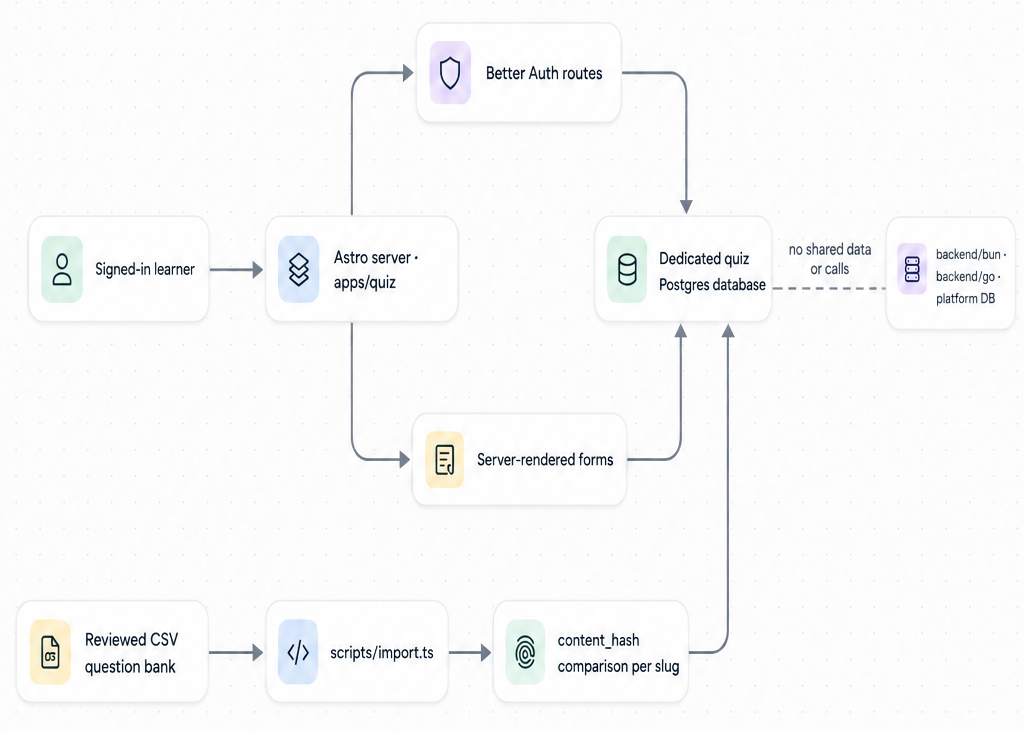
| Concern | Choice |
|---|---|
| Adapter | @astrojs/node with output: 'server' |
| Rendering | Server-side full-page loads; no client framework |
| Database | A new database on the existing Postgres instance |
| Query layer | pg Pool with hand-written parameterised SQL; no ORM |
| Authentication | Better Auth on the same Pool; database IDs pinned to UUID |
| Auth email | SMTP through nodemailer for verification and reset |
| Styling | Tailwind CSS v4 through @tailwindcss/vite |
| Content format | CSV parsed with csv-parse/sync; zod validates before any write |
| Markdown | marked renders the three Markdown columns once during import |
Runtime dependencies are astro, @astrojs/node, tailwindcss, @tailwindcss/vite, better-auth, pg, zod, marked, and nodemailer. csv-parse is a development dependency because only the import script uses it and it never runs in the server process. Development dependencies also include vitest, playwright, required type packages, and the Better Auth CLI pinned to exactly the runtime package version; the two Better Auth versions move together.
Data model
Better Auth's pinned CLI owns user, session, account, and verification. The app owns four tables. Every primary key is uuid with gen_random_uuid(); every timestamp is timestamptz.
Question
| Column | Type | Meaning |
|---|---|---|
id | uuid PK | Generated identity |
slug | text UNIQUE NOT NULL | Hand-written import identity from the CSV Slug column, e.g. saa-c03-athena-s3-logs |
exam_type | text NOT NULL | From the CSV filename stem: saa-c03, gcp-ace, … |
body | text NOT NULL | Question text as plain text, escaped on output |
explanation_md / explanation_html | text NOT NULL | Why the correct answer is correct |
study_note_md / study_note_html | text NULL | Optional remarks, tips, or study guide |
tags | text[] NOT NULL DEFAULT '{}' | GIN-indexed tags such as {athena,s3,sql} |
community_vote_label | text NULL | Crowd-preferred labels, e.g. A, AB |
community_pct | int NULL | Crowd agreement 0–100, stored without the % |
pdf_suggested_label | text NULL | The published answer key's labels |
content_hash | text NOT NULL | SHA-256 of the source row; drives import change detection |
retired_at | timestamptz NULL | NULL while eligible for new sessions |
created_at / updated_at | timestamptz NOT NULL DEFAULT now() | Lifecycle timestamps |
Indexes: unique slug, btree exam_type, and GIN tags. Stable slugs keep old attempts attached after wording corrections. Arrays avoid a tag and join table: WHERE tags @> ARRAY['athena'] uses GIN, while SELECT DISTINCT unnest(tags) supplies filter values. Pull-request review controls typos.
Answer option
| Column | Type | Meaning |
|---|---|---|
id | uuid PK | Stable option identity |
question_id | uuid FK → question, cascade delete | Owning question |
label | text NOT NULL | A–E |
body | text NOT NULL | Option text as plain text, escaped on output |
is_correct | boolean NOT NULL | Supports one or multiple correct options |
why_wrong_md / why_wrong_html | text NULL | Required for an incorrect option, forbidden for a correct one |
position | int NOT NULL | Display order |
Constraints: unique (question_id, label), unique (question_id, position), and a CHECK requiring both why-wrong fields to be NULL exactly when the option is correct. Per-option correctness gives “choose TWO” and single-answer questions one schema; per-option rationale lets feedback sit beside the relevant option.
Exam
| Column | Type | Meaning |
|---|---|---|
id | uuid PK | Exam identity |
user_id | uuid FK → "user"(id), cascade delete | Owner |
exam_type | text NOT NULL | Selected certification |
question_count | int NOT NULL | Actual selected count |
duration_minutes | int NOT NULL | Configured duration |
started_at | timestamptz DEFAULT now() | Database start time |
deadline_at | timestamptz NOT NULL | Immutable timer authority |
submitted_at | timestamptz NULL | NULL means in progress; no status column |
Constraints and indexes: unique (id, user_id) supports the ownership-preserving attempt foreign key; question count is 1–200; duration is 1–480; deadline_at > started_at; unique (user_id) WHERE submitted_at IS NULL permits one active exam; (user_id, submitted_at) supports history and resume.
Attempt
| Column | Type | Meaning |
|---|---|---|
id | uuid PK | One question-you-were-given |
user_id | uuid FK → "user"(id), cascade delete | Owner |
question_id | uuid FK → question, restrict delete | Preserves historical question access |
exam_id | uuid NULL | NULL means practice; paired with user in the FK |
position | int NULL | Required in exam, NULL in practice |
selected_option_ids | uuid[] NOT NULL DEFAULT '{}' | Submitted answer set |
revealed_option_ids | uuid[] NOT NULL DEFAULT '{}' | Practice-only eliminated options |
is_correct | boolean NULL | NULL until answered |
answered_at | timestamptz NULL | Paired with correctness |
created_at | timestamptz DEFAULT now() | Attempt creation time |
Constraints: (exam_id, user_id) REFERENCES exam(id, user_id) ON DELETE CASCADE; position is present exactly for exam attempts; answered_at and is_correct are both NULL or both set; exam attempts cannot reveal options. Indexes: (user_id, question_id); unique exam position for non-NULL exam_id; and one unanswered practice row per (user_id, question_id).
Exam roster
creationN unanswered rows fix the selected questions and order.
Resume
durableEach answer updates immediately; reopening restores exact progress.
Practice history
append-onlyexam_id IS NULL; “Try again” inserts instead of overwriting.
Statistics
future-readyAggregate answered rows; cardinality(revealed_option_ids) = 0 isolates unaided correct answers.
Abandoned practice loads never count as wrong. Exam submission explicitly marks blank roster rows incorrect. The data needed for per-user, exam-type, question, and tag statistics therefore accumulates before a statistics screen exists.
Question content and import
Who owns question content?
Git CSV files authored in a spreadsheet: apps/quiz/content/saa-c03.csv, apps/quiz/content/gcp-ace.csv, and one file per later exam type. The filename stem is the exam_type — no column or manifest carries it.
The database question and option rows are derived projections. Pull-request merge rights are the authoring permission model, so the runtime needs no role column, editing permissions, or admin UI. CSV beats JSON here because the bank is authored and reviewed in a spreadsheet, where one row per question is far easier to scan than nested JSON.
The cost is that CSV carries no types and no nesting, so several columns are parsed by convention and validated strictly. Operational user, exam, and attempt data is never rebuildable from git.
CSV column mapping
One header row, then one question per row. Header names must match exactly; an unexpected, missing, or misspelled column fails the import rather than being silently ignored, because a spreadsheet makes that mistake easy.
| Column | Required | Maps to |
|---|---|---|
Slug | yes | question.slug |
ID | ignored | Row index; never imported |
Q# | ignored | Always ID + 1; never imported |
Question | yes | question.body (plain text) |
A B C D | yes | One answer_option each |
E | optional | A fifth answer_option when non-empty |
My Answer | yes | Defines answer_option.is_correct |
Community Vote | optional | question.community_vote_label |
Community % | optional | question.community_pct, integer: 97% → 97 |
PDF Suggested | optional | question.pdf_suggested_label |
Flag | ignored | Fully derivable from the two columns above; never stored |
Why Correct | yes | question.explanation_md |
Why Wrong | yes | Split across the incorrect answer_option rows |
Study Note | optional | question.study_note_md |
Tags | optional | question.tags, semicolon-separated |
Slug is one short hand-written identifier per row, e.g. saa-c03-serverless-flash-sale-site, matching ^[a-z0-9-]+$ and unique across every file. My Answer is the correct answer — your own reviewed conclusion, and what the app scores against. Community Vote and PDF Suggested are provenance only. All three use the same format: one or more label letters with no separator (A, C, AB), read case-insensitively and order-insensitively.
Tags are trimmed, lowercased, and have inner whitespace hyphenated, so S3; Transfer Acceleration becomes {s3, transfer-acceleration} — URL-safe and consistently cased. Empty segments are dropped.
Why Wrong parsing
Why Wrong packs every wrong-option explanation into one cell as a Markdown bullet list, one entry per line:
- **A:** S3 can only serve files. It cannot run the code that takes an order, and S3 is not a database.
- **B:** EC2 instances, two load balancers, and an RDS database all have to be sized, patched, and monitored by you.
- **C:** Running Kubernetes on EKS means you manage a cluster, node groups, and pod scaling.line_pattern^- \*\*([A-E]):\*\*\s+(.+)$on every non-blank linestrictlabel_setMust exactly equal the present-but-incorrect options — no missing, no extraexactno_continuationOne entry per line; a wrapped line is indistinguishable from a malformed entry1verifiedEntries parsed across the 40 current rows with zero anomalies120
A line that does not match is a validation error, never skipped. The captured text after the label is stored as why_wrong_md for that option; the - **A:** prefix is consumed by the parser and never stored, since the UI renders each explanation beside its own option and would otherwise repeat the label.
The parser runs with columns: true, bom: true, skip_empty_lines: true, and strict column counts. bom: true matters: spreadsheets routinely write a UTF-8 byte-order mark that would otherwise corrupt the first header name.
Importer pipeline
scripts/import.ts runs as pnpm run import or pnpm run import --dry-run. It always reads the entire content/ directory — there is no single-file mode, because retirement can only be decided from the complete source set.
- Parse every CSV
Read all
*.csvfiles incontent/. The filename stem setsexam_typefor every row in that file. - Validate before any write
Zod checks exact header names; present, well-formed, globally unique
Slug; non-emptyA–Dwith optionalE; aMy Answerthat references only present options and never selects every option;Why Wronglines matching the bullet pattern with an exact label set;Community %within 0–100; andCommunity Vote/PDF Suggestedreferencing present options. At least one file and one row are required, so an empty directory cannot retire the whole bank. - Render Markdown
markedrenders the three Markdown fields; question and option bodies are stored as plain text. - Classify by content hash
Compute a
content_hashper row and classify every slug as new, changed, unchanged, restored, or retired. - Write in one transaction
Lock
examagainst inserts, finalise expired exams, then abort and report remaining active exam IDs. Upsert new, changed, and restored questions byslugwithretired_at = NULL; upsert options by(question_id, label)to preserve IDs through wording and ordering edits; delete only labels removed from that question; then setretired_aton previously active questions absent from the source set.
Change detection
Each question row carries a SHA-256 content_hash over a canonical serialisation of every source-derived value: slug, exam type, body, explanation, study note, sorted tags, the provenance columns, and each option's label, body, correctness, and why-wrong text sorted by label. Anything that would change a database row changes the hash; nothing else does. That reduces “what has been imported and what has not” to one comparison per slug.
| Class | Condition | Action |
|---|---|---|
| New | Slug not in the database | Insert question and options |
| Changed | Slug present, hash differs | Update question and options |
| Unchanged | Slug present, hash identical | Skip entirely — no write |
| Restored | Slug present with retired_at set | Clear retired_at, then treat as changed |
| Retired | Active slug absent from the source set | Set retired_at; never delete |
Skipping unchanged rows is what makes this usable as files grow and accumulate. It also keeps question.updated_at honest: it moves only when the content actually moved, so it is a real “last edited” timestamp rather than “last time anyone ran the importer”. The importer prints a summary and exits non-zero on validation failure:
saa-c03.csv    40 rows    2 new   3 changed   35 unchanged
gcp-ace.csv    25 rows   25 new   0 changed    0 unchanged
retired: 1 (saa-c03-old-question)--dry-run performs every step including classification and the summary, then rolls the transaction back. It is the safe way to see what a spreadsheet edit would do before it does it. The hash comparison plus the slug upsert make the import idempotent: running it any number of times converges on the same state, and question.id never changes, so all existing attempt rows stay attached.
Removing a whole question from git retires it instead of deleting it. Retired questions are excluded from new exams, practice lists, filters, and random selection, but remain readable through historical results. Re-adding the same slug clears retirement and preserves identity.
Migration order
Quiz migrations are filename-ordered SQL under apps/quiz/migrations/, applied by scripts/migrate.ts and recorded in schema_migration(version, applied_at). Better Auth tables come from the repository-pinned CLI, never a floating pnpm dlx ...@latest.
- Create the dedicated quiz database on the existing Postgres instance.
- Enable
pgcryptoforgen_random_uuid(). - Run the pinned Better Auth CLI migration non-interactively.
- Assert that
"user".idhas PostgreSQL typeuuid. - Run
scripts/migrate.ts, thenscripts/import.ts.
pnpm run setup:db chains this order so application foreign keys never precede the auth schema they reference.
Authentication and request security
export const auth = betterAuth({
  database: pool,
  advanced: { database: { generateId: 'uuid' } },
  emailAndPassword: {
    enabled: true,
    requireEmailVerification: true,
    sendResetPassword,
  },
  emailVerification: { sendVerificationEmail, sendOnSignUp: true },
  databaseHooks: { user: { create: { before: assertEmailAllowed } } },
});
Eligibility
allowlistQUIZ_ALLOWED_EMAILS is trimmed and lowercased once at startup. Empty or missing rejects every sign-up.
Ownership proof
verified emailAllowlisting is not mailbox proof. Sign-in stays blocked until verification; reset email recovers pre-claimed or forgotten credentials.
Configuration
fail-fastAuth secrets and SMTP validate at startup. BETTER_AUTH_SECRET must be at least 32 characters.
Production hardening
built-inSecure cookies and Better Auth rate limits are enabled. Proxy IP headers are trusted only with an explicitly configured proxy chain.
Verification and reset callbacks are absolute URLs derived from BETTER_AUTH_URL; request headers never guess the public origin. The catch-all endpoint at src/pages/api/auth/[...all].ts exports export const ALL: APIRoute = ({ request }) => auth.handler(request);.
src/middleware.ts resolves the session into locals.user and redirects unauthenticated users to /sign-in. Public paths are /sign-in, /sign-up, /verify-email, /forgot-password, /reset-password, /api/auth/*, and static assets. Unverified users cannot enter protected pages.
Better Auth protects its own /api/auth/* mutations. Application authorization is ownership-only: users can read and write only their own exams and attempts; all signed-in users can read questions; nobody can write questions at runtime. Foreign exam IDs return 404 rather than confirming existence with 403.
Application structure
frontend/astro/apps/quiz/
├── content/
│   ├── saa-c03.csv
│   └── gcp-ace.csv
├── migrations/
│   └── 001_quiz.sql
├── scripts/
│   ├── migrate.ts
│   └── import.ts
└── src/
    ├── lib/
    │   ├── auth.ts          Better Auth server + allowlist hook
    │   ├── config.ts        fail-fast environment parsing and numeric bounds
    │   ├── db.ts            pg Pool singleton
    │   ├── email.ts         SMTP verification and reset mail
    │   ├── queries.ts       all SQL, one exported function per query
    │   ├── scoring.ts       pure selected-set scoring
    │   └── clues.ts         pure clue limit and next reveal
    ├── middleware.ts
    ├── layouts/QuizLayout.astro
    ├── components/
    │   ├── QuestionBody.astro
    │   ├── OptionList.astro
    │   ├── ExplanationPanel.astro
    │   └── ExamTimer.astro
    └── pages/
        ├── index.astro
        ├── sign-in.astro
        ├── sign-up.astro
        ├── verify-email.astro
        ├── forgot-password.astro
        ├── reset-password.astro
        ├── api/auth/[...all].ts
        ├── exam/new.astro
        ├── exam/[id]/[position].astro
        ├── exam/[id]/result.astro
        ├── practice/index.astro
        └── practice/[slug].astro
scoring.ts and clues.ts stay pure and database-free. queries.ts is the only SQL-writing module; pages call named query functions. src/lib/config.ts parses environment values once, so page code never reads raw process.env or invents fallback limits.
Exam mode
Creating an exam
GET /exam/new renders exam type, question count, and duration. Defaults are QUIZ_DEFAULT_QUESTION_COUNT=65 and QUIZ_DEFAULT_DURATION_MINUTES=90, but each exam may override them within 1–200 questions and 1–480 minutes.
- Resolve the active exam
In one transaction using the database clock, finalise the user's expired exam. If an active exam remains, 303-redirect to its first unanswered position. The partial unique index resolves concurrent creates to the same active exam.
- Select a roster
Run
SELECT id FROM question WHERE exam_type = $1 AND retired_at IS NULL ORDER BY random() LIMIT $2. If no question exists, re-render the form without inserting. - Persist the deadline
Insert
examwith the actual selected count anddeadline_at = transaction_timestamp() + duration_minutes. A smaller bank yields a smaller valid exam and is disclosed on the result screen. - Fix the sequence
Insert unanswered attempt rows at positions
1..N, then 303-redirect to/exam/:id/1.
Answering
GET /exam/:id/:position guards in order: foreign ownership → 404; already submitted → result; database now() >= deadline_at → finalise then result; invalid position → first unanswered. The page shows one question, a countdown, and a numbered position grid with answered state. Exactly one correct option renders radios; multiple correct options render checkboxes. No clues, answers, explanations, or study notes appear during an active exam.
The POST repeats ownership, submission, deadline, and position guards inside a transaction while locking the exam row with SELECT ... FOR UPDATE. It deduplicates submitted IDs, rejects IDs outside the question, persists selection, correctness, and answer time, then redirects to the next unanswered position. When none remain it submits and redirects to results. A previously answered row may be overwritten only while the exam is active and another position remains unanswered.
Scoring and results
Scoring is all-or-nothing: the normalized selected option ID set must exactly equal the correct option ID set. Partial “choose TWO,” over-selected, and blank answers score zero.
GET /exam/:id/result shows correct/total, percentage, time taken, and every question in order with the user's answer, correct answer, explanation, why-wrong text for each incorrect option, study note, and tags. A past-deadline active exam is finalized first; a still-active exam redirects to the first unanswered position. Results are never exposed before submission.
Practice mode
GET /practice lists non-retired questions filtered by exam type and tag, labels each with the user's most recent answered result, and offers a random question within the active filter.
Current attempt
GET /practice/:slug loads the unique unanswered practice attempt, creating it with INSERT ... ON CONFLICT DO NOTHING when absent and then selecting the winning row. Creating on page load makes clue state survive refreshes. A retired slug is readable only through history and cannot start a new attempt.
Progressive clues
clue_limitmin(QUIZ_MAX_CLUES, wrongOptionCount − 1)N−1four_option_single3 wrong options; always leave 2 selectable2five_option_choose_two3 wrong options; always leave 2 selectable2
- Lock the current attempt with
SELECT ... FOR UPDATE. - If revealed count reached the limit, do nothing and 303-redirect back; the button is already hidden.
- Otherwise choose a random unrevealed incorrect option, append it to
revealed_option_ids, and 303-redirect.
The lock serializes rapid clue requests so they cannot duplicate a reveal, exceed the limit, or lose updates. Revealed options are dimmed and struck through, display their why-wrong rationale, and cannot be selected. The −1 cap ensures a clue never hands over the answer.
Answering and retrying
action=answer locks the same attempt, normalizes IDs, and rejects foreign option IDs or any option already eliminated. It then stores selection, correctness, and answer time. Replaying the POST cannot overwrite an answered attempt.
A clue-assisted correct answer still counts as correct; the revealed-ID count preserves the later distinction between aided and unaided accuracy. “Try again” creates a fresh unanswered attempt through the same conflict-safe path, so practice history accumulates.
Timer
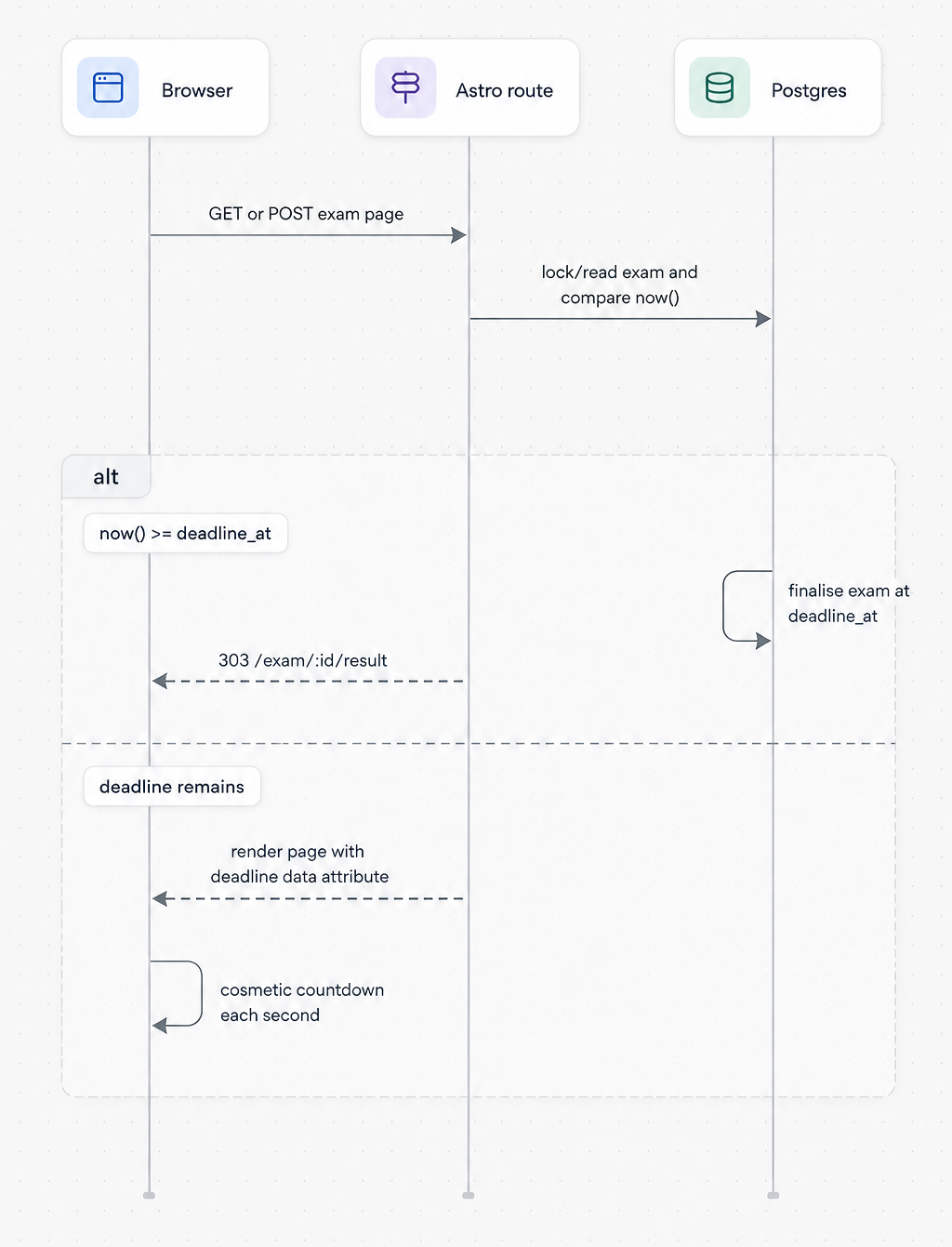
exam.deadline_at is written once and never changed. Every exam GET and POST compares the database clock under the exam-row lock. The roughly ten-line client script reads a data- attribute, updates once per second, and navigates to results at zero. Closing a tab, suspending a phone, pausing JavaScript, or editing the page cannot add time because the server never consults the client clock.
Error handling
| Situation | Behaviour |
|---|---|
| Foreign or missing exam ID | 404 |
| Position out of range | Redirect to first unanswered; if none, finalise and show results |
| Exam already submitted | Redirect to result |
| Request after deadline | Auto-submit and redirect to result |
| Result before submission | Redirect to first unanswered |
| Clue past the limit | Ignore and redirect back without an error |
| Clue in exam mode | No route and no rendered button |
| Answer with no selection | Accept and score incorrect |
| Option foreign to question | 400; no mutation |
| Option eliminated by clue | 400; no mutation |
| Missing or foreign application POST Origin | 403; no mutation |
| Import validation failure | No database write; identify file, slug, and field |
| Non-allowlisted sign-up | Generic “sign-up is not available for this address” |
| Sign-in before verification | Reject and offer verification-email resend |
| Exam type with no questions | Re-render form; create nothing |
| Invalid count or duration | Re-render with bounded validation message |
Configuration
| Variable | Purpose |
|---|---|
QUIZ_DATABASE_URL | Dedicated quiz Postgres connection |
BETTER_AUTH_SECRET | Session signing secret; at least 32 characters |
BETTER_AUTH_URL | Canonical public base URL and Origin authority |
QUIZ_ALLOWED_EMAILS | Comma-separated sign-up allowlist; empty rejects all |
QUIZ_DEFAULT_QUESTION_COUNT | Default 65; editable per exam; bounded 1–200 |
QUIZ_DEFAULT_DURATION_MINUTES | Default 90; editable per exam; bounded 1–480 |
QUIZ_MAX_CLUES | Default 3; non-negative upper bound before the wrong-minus-one cap |
QUIZ_SMTP_HOST / QUIZ_SMTP_PORT | SMTP endpoint |
QUIZ_SMTP_USER / QUIZ_SMTP_PASSWORD | SMTP credentials |
QUIZ_EMAIL_FROM | Verified auth-email sender |
Configuration is validated once at startup, and defaults obey the same bounds as submitted values. Invalid or incomplete production configuration stops the server rather than weakening auth or changing exam rules.
Testing and success criteria
Unit · Vitest · no database
scoring.ts: single-answer success/failure; choose-two exact, partial, and over-selected sets; empty selection.clues.ts:min(3, wrong − 1); representative four-option and five-option cases both yield two; never pick correct or repeat a revealed option.- Deadline comparison before, exactly at, and after
deadline_at. - Import validation rejects a duplicate slug, a slug failing
^[a-z0-9-]+$, a missing or misspelled header column, an emptyMy Answer, aMy Answernaming an absent option or selecting every option, aCommunity %above 100, and anEvalue with an emptyD. Why Wrongparsing splits the- **B:** …bullet list into the right options and strips the label prefix; rejects a missing label, an extra label naming a correct option, a non-matching line, and a wrapped continuation line. Round-trips all 120 entries across the 40 real rows with zero anomalies.- Answer-label parsing normalizes
A,AB,ba, andA Bto the same label set; rejectsAAandAF. - Tag normalisation turns
S3; Transfer Acceleration;into{s3, transfer-acceleration}. - Markdown scope:
explanation,study_note, andwhy_wrongrender to HTML; question and option bodies pass through unrendered and are escaped on output. content_hashis identical for identical input and unchanged by reordering tags or options; it changes when any imported field changes and never changes for an ignored column (ID,Q#,Flag).- Submitted-option validation rejects foreign, duplicate, and revealed IDs; scoring uses normalized sets.
Integration · real Postgres
- Import twice without changing row count; update an explanation in place; preserve
question.idand attempt resolution. - A second import with no file edits classifies every row unchanged, performs no writes, and leaves every
updated_atuntouched. - Editing one cell classifies exactly that row as changed and every other row as unchanged.
- Two files in
content/import as two exam types; adding a second file leaves the first file's rows unchanged and retires none of them. --dry-runreports the same classification as a real run and commits nothing.- A no-op import succeeds while an exam is active; an import with real changes aborts and names the active exam.
- Remove an option while preserving survivor IDs; historical selections show the removed-option placeholder.
- Remove, retire, exclude, historically render, and re-add a question with the same ID.
- Exam creation inserts exactly N attempt rows at positions
1..N. - Concurrent practice loads yield one unanswered attempt; concurrent clues cannot exceed the limit.
- A deadline POST racing a result GET produces one submitted exam and no late persisted answer.
- The generated Better Auth schema exposes
"user".idas PostgreSQLuuidbefore app migration.
End-to-end · Playwright
- Sign in, start an exam, answer two, reload, recover selections and correct remaining time, submit, and verify score.
- Opening an exam after its deadline auto-submits.
- A cross-origin application POST is rejected without mutation.
- Use every practice clue, observe the button disappear, answer, then see why-wrong feedback for all incorrect options including never-revealed ones.
- Reject a non-allowlisted sign-up; block an allowlisted user before verification; complete a password reset.
Out of scope for v1
Immutable question revisions — planned phase 2
v1 refuses to import while any exam is in progress. That is safe but assumes a maintenance window. Once several people take exams throughout the day there may be no moment when nothing is active, and the question bank becomes impossible to update. The fix is to stop editing questions in place: every import creates a new immutable revision, and each exam is pinned to the revision it started with.
- Alice starts an exam using question 10, revision 1.
- An import creates question 10, revision 2.
- Alice's active exam keeps showing and scoring revision 1.
- Exams started after the import use revision 2.
- Revision 1 stays readable for Alice's result and historical review.
| Table | Holds |
|---|---|
question | Permanent identity only: id, slug, exam_type, retired_at |
question_revision | One row per version: body, explanation, study note, tags, provenance columns, content_hash, created_at |
answer_option | Re-parented from question to question_revision |
attempt | Gains question_revision_id, captured when the exam roster is created or a practice attempt begins |
The importer inserts a new question_revision when content_hash differs instead of updating, and never mutates an existing revision. Reads resolve through attempt.question_revision_id for history and through the latest non-retired revision for new sessions.
Migration from v1: each existing question becomes identity plus one revision — its content columns and content_hash move to revision 1, its answer_option rows re-parent to revision 1, and every existing attempt backfills question_revision_id to that revision. No attempt history is lost, because option IDs are carried over rather than regenerated.
Other deferrals
Favourites
deferredA future favourite table plus filter.
Statistics screen
UI onlyAttempt data is collected now; presentation comes later.
Vector embeddings
cutNo semantic-search use case. Exam type and tag filters suffice; revisit with concrete need and pgvector precedent in backend/go's digitalworker module.
Admin editing UI
unneededGit and pull requests remain the authoring workflow.
Question images
no current needCurrent source material is text-only.
Exam review flags
omittedThe numbered question grid already supports navigation.
OAuth
omittedVerified email and password fit the small known user set.