DW Semantic History Search — Design
Adds local, pgvector-based semantic search over Digital Worker chat history. The current Postgres FTS ('simple' config) cannot segment Chinese or code-switched rojak, leaving 40% Malay + 10-20% Chinese chat effectively unsearchable; local bge-m3 embeddings fix this with no API cost and enable cross-lingual retrieval. Approved after the 2026-07-22 grill session resolved all open questions.
Digital Worker chat-history search runs on Postgres full-text search that cannot read Chinese or code-switched "rojak" — so the 40% Malay and 10–20% Chinese portions of the chat are effectively unsearchable today. This design adds local, pgvector-based semantic search using bge-m3 embeddings, produced by a single periodic watermark sweep and merged into the existing search path. Approved after the 2026-07-22 grill session resolved every open question.
Problem
DW chat history search today uses Postgres full-text search
(HistorySearchRepository.Search, learning_repositories.go:533):
search_tsv @@ plainto_tsquery('simple', ?)Semantic search is the only approach that works for zh/ms/rojak recall, and it enables cross-lingual retrieval (跨语言检索): a query in one language finds relevant messages written in another.
Goals & Non-Goals
Goals
in scope- Semantic search for English, Malay, Chinese, and code-switched messages.
- Local, free, private — no chat content sent to third-party APIs.
- Feature-flagged so it can be turned off entirely.
- Embedding model configurable, swappable later without code changes.
Non-Goals (deferred)
out of scope- Semantic memory injection — stays ADR-0034 recency-ranked until the over-budget signal.
- Reranker — phase 2.
- Cross-domain search / platform embedding standard — per-domain models instead.
- Paid models (OpenAI/Voyage) — local is enough; privacy + zero cost.
- Inline embedding on ingest — the sweep handles it.
- MRL / truncation and an ANN index — corpus too small.
Key Decisions
| # | Decision | Rationale |
|---|---|---|
| 1 | Per-domain models; no cross-domain search | Keeps DW isolated from ai/crm |
| 2 | bge-m3 (1024-dim), local via Ollama | Handles rojak natively, strong on Malay (low-resource) |
| 3 | Embed raw — no LLM/translation normalization | One deterministic step; normalization adds cost + non-determinism |
| 4 | No MRL / no truncation — full 1024 dims | Small corpus; MRL solves a scale problem we don't have |
| 5 | halfvec(1024) + halfvec_cosine_ops | Half the storage of vector; cosine is standard |
| 6 | Own table dw_message_embeddings | Different model/dim from the ai module's vector(1536) |
| 7 | Store model column; always filter by it | Two models never share a vector space, even at equal dims |
| 8 | One periodic watermark sweep (no enqueue, no separate backfill) | A window can only embed after it closes; one path gives async, retry, backfill, model-swap |
| 9 | Substance filter on windows, not messages | A trivial "ok" inside a window is often the answer; skip only tiny windows |
| 10 | Chunk as small conversation windows | Biggest accuracy lever; chat meaning spans several short messages |
| 11 | Feature flag master switch | Ship dark, roll out per environment |
| 12 | Embedding model configurable, default bge-m3 | Swap models later (a re-embed job) without code changes |
How are embeddings produced?
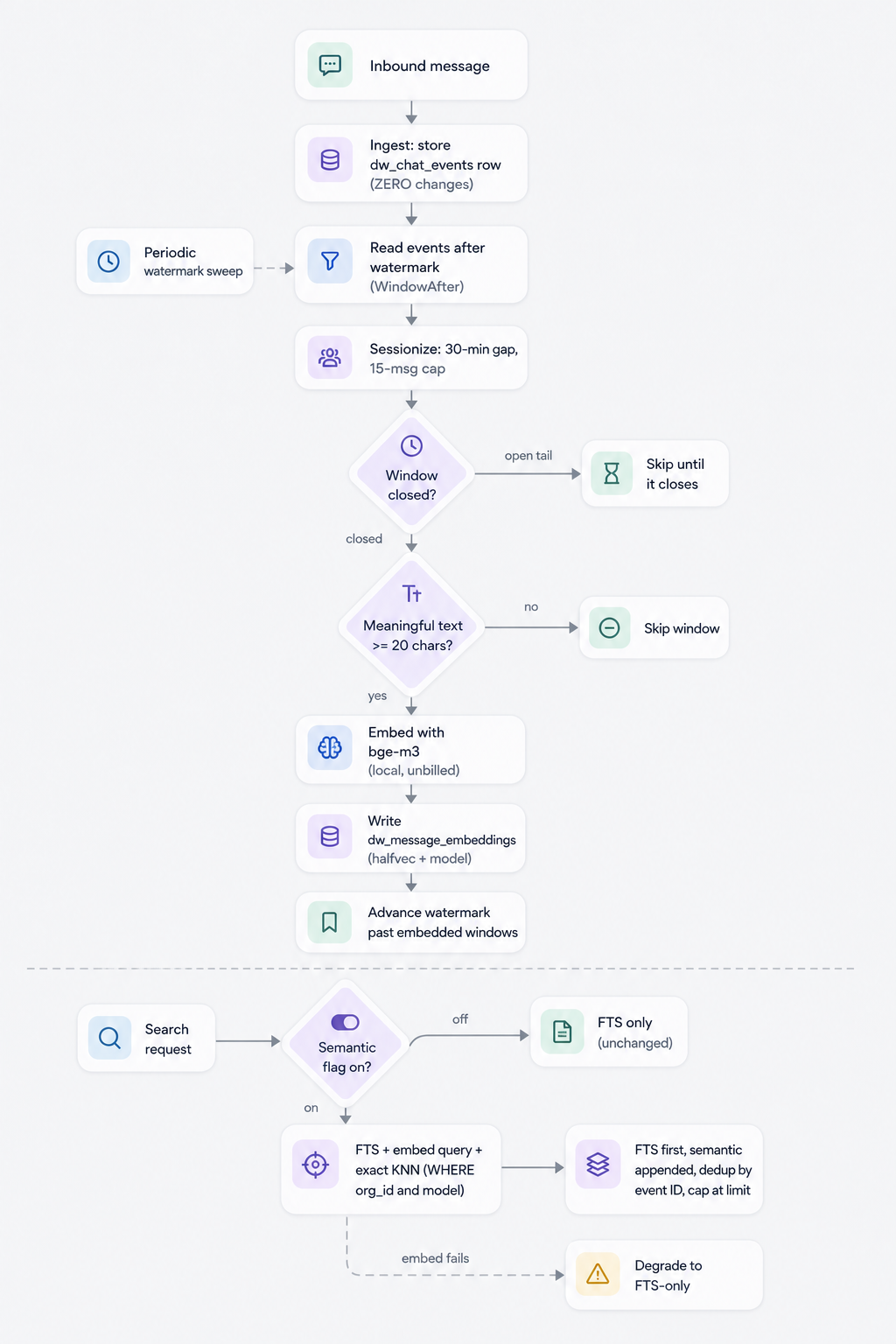
One periodic watermark sweep over closed conversation windows.
A window can only be embedded after its session closes, so per-message jobs are
the wrong shape. A single sweep, keyed per (org, provider, channel, model)
watermark, gives async embedding, retry (watermark stalls on transient failure),
backfill (empty watermark), and model-swap rebuild in one code path. Ingest is
untouched.
Rejected: enqueue-on-ingest + worker + separate backfill — three moving parts for a job that can't run until a session closes anyway.
Which vector index?
None — btree on (org_id, model) + exact KNN.
Retention coupling caps the table at ~30 days of windows (hundreds to low-thousands of vectors per org), where exact scan is single-digit ms with perfect recall.
Rejected: HNSW/IVFFlat — filtered ANN post-filters on org_id/model
(can under-return or miss hits) and IVFFlat needs training data. Revisit HNSW only
near ~50–100k live vectors per org.
Architecture
Data Model
dw_message_embeddings
  id            uuid pk
  org_id        varchar   -- tenancy scope; every query filters on it
  model         varchar   -- e.g. 'bge-m3'; every query filters on it (#7)
  embedding     halfvec(1024)          -- (#5)
  content       text      -- the exact chunk text that was embedded
  source_message_ids  ...  -- which dw_chat_events rows this chunk covers (#10)
  channel / provider / time-range metadata  -- to map a hit back to messages
created_at timestamptzSubstance Filter — window-level
The substance filter applies to the completed window, never to individual messages. Every message inside a qualifying window is retained — a trivial "ok" or "BetterAuth" is often the answer to the preceding question; dropping it per-message would delete meaning from the chunk.
Chunking — time-gap sessions
Embed small conversation windows, not single messages. Chat meaning spreads across short fragments ("migrate 那个" / "Clerk 还是 BetterAuth?" / "BetterAuth"), so per-message embedding fragments the meaning and misses it.
- Scope: strictly
(org_id, provider, external_channel_id)— never crosses channels/providers. - Eligibility: the existing
WindowAfterpredicate (event_type='message',decision IN ('received','processed')) — denied/verification traffic never embedded. - Session split: a new window starts after a 30-minute gap.
- Cap: max 15 messages per window + the model input limit; a capped session continues in the next window.
- No overlap in phase 1; no threads (
ExternalThreadIDis dropped bychatEventRow— a schema change, not phase 1). - The 30-min gap and 15-message cap are named, tested constants.
Configuration & Feature Flag
- Master switch (#11)
- Two-tier flag
digital_worker_semantic_search(admin_feature_flagsseeded OFF +org_feature_flags), checked in addition to the moduledigital_workerflag. Off → the sweep is a no-op and search falls back to FTS; ingest unchanged either way. - Configurable model (#12)
- Deployment-level env config
DigitalWorker.EmbedModel(defaultbge-m3), reusingOllamaURL. Not per-org — the model must match what the Ollama host serves, and model identity defines the vector space. Changing it starts the new model's watermark empty; search filters by the active model so old/new vectors never mix. - Heuristics
- The 20-char substance threshold, 30-min gap, and 15-message cap are named, tested Go constants — nothing new in
org_module_configs.
Phasing
-
Phase 1 — this design
Watermark embedding sweep over closed windows,
dw_message_embeddingstable, hybrid search inside the existingSearchAgentHistorypath (no new endpoint), feature flag, configurable model. -
Phase 2 — local reranker
bge-reranker-v2-m3: retrieve top ~50 by vector search → rerank → return top ~5–10. Add when precision complaints appear. Runs as a separate local inference service (TEI/Infinity), not Ollama.
Testing Approach — two tiers
Deterministic vectors keyed by input text, against the test Postgres (verify pgvector in test-DB migrations). Covers: windowing (gap split, 15-msg cap, continuation), window substance filter, watermark (advance, transient stall, poison skip), hybrid merge/dedup/limit, model-filter, query-time degradation to FTS, flag-off no-op, retention purge.
t.Skip unless the Ollama env var is set. Seed rojak/zh/ms/en messages; assert an English query retrieves the semantically-matching non-English message (cross-lingual recall). Validates the model, not the code — a required rollout-checklist item before enabling an environment's flag.
Resolved Questions
All five original open questions were closed in the 2026-07-22 grill session:
| Question | Resolution |
|---|---|
| Substance threshold | Window-level length heuristic, ~20 chars of meaningful text; no triage reuse, no AI check. |
| Windowing rule | Time-gap sessions (30 min) capped at 15 messages, per (org, provider, channel); no overlap; no threads. |
| Index type | Neither — exact KNN + btree on (org_id, model); HNSW only near ~50–100k live vectors. |
| Config surface | Two-tier digital_worker_semantic_search flag; EmbedModel env default bge-m3; heuristics as Go constants. |
| Backfill scope | Moot — retention coupling means backfill = all live rows; nothing older exists. |